As a Student Union the KSA is Not Only Failing Students — They’re Misleading Them
Student unions are right to criticize the provincial government’s post-secondary review. That criticism is justified, and students should be demanding more from a process that could reshape the entire public education system.
According to The Ubyssey, student leaders across British Columbia were given a six-week consultation window, a single short meeting with the review chair, and little clarity on whether the process will protect core issues like tuition caps or long-term public funding. For something framed as a comprehensive review, that level of engagement feels thin.
The broader context makes the stakes even clearer. International enrolment is being capped, institutional budgets are under strain, and governments have a long history of using “reviews” to quietly normalize unpopular decisions. Students are right to treat this one with skepticism.
While student unions are pushing back on provincial transparency, something far more unsettling is happening inside their own organizations.
At the Kwantlen Student Association, students are being presented with steady reassurances while the internal reality looks increasingly bleak.
In January, The Runner reported that the Speaker of KSA council had not received a single executive or committee report since the start of her term, despite more than twenty being expected. Only one vice-president submitted anything resembling a substantive report. For an organization funded by mandatory student fees, this is a serious governance failure. Without regular reporting, neither council nor students have any reliable way to assess what their leadership is actually doing.
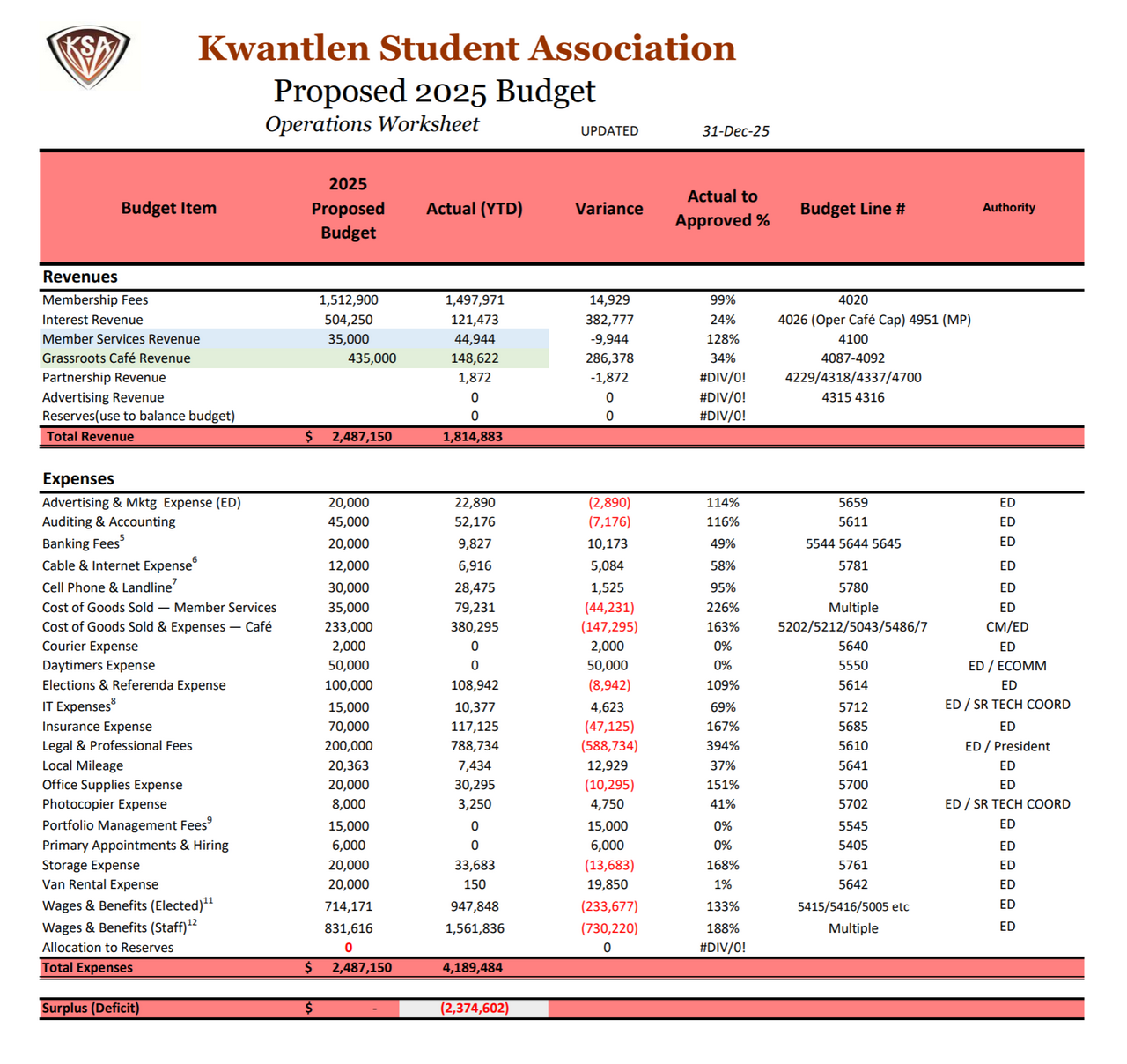
At the same time, the KSA is facing what its own financial documents describe as a seven-figure financial deficit, a deteriorating public reputation, and a relationship with KPU administration that has become visibly strained. The association’s credibility has taken a hit both on campus and beyond it. Even the university itself appears increasingly uncomfortable with the conduct of its own student leadership.
Despite all of this, students continue to hear confident messaging. Public statements from KSA executives emphasize hard work, progress behind the scenes, and ongoing advocacy. What is missing is evidence. There is little available documentation showing what a full year of executive leadership has delivered for students, beyond financial instability and internal disorder.
This gap between messaging and reality is what makes the situation particularly troubling.
Many of the people closest to the organization’s day-to-day operations are not in a position to speak openly. Staff are expected to keep things running while navigating shifting roles, unclear authority, and professional limits on what they can say publicly. They see the problems up close, but cannot realistically become the ones to raise alarms.
The result is a closed loop. Students hear reassuring narratives from leadership. Council meetings remain opaque and disseminate minimal information. Staff are constrained from speaking. Meanwhile, the organization continues to slide deeper into crisis without meaningful accountability.
This goes beyond poor management. It creates an environment where students are effectively asked to take everything on faith. No reports. No measurable outcomes. No transparent accounting of how an entire year of governance translated into tangible benefit for the people paying for it.
That is not just a public relations problem. It undermines the basic premise of student representation.
Student unions exist to act on behalf of students, not to manage impressions. They exist to justify the trust placed in them through clear records, open governance, and real results. When those foundations erode, so does the legitimacy of every external claim they make.
Which is why the current moment feels so deeply ironic. Student unions across B.C. are criticizing government for rushed processes, vague consultations, and decisions being made without proper oversight.
At Kwantlen, students are living inside a version of that same problem.
A student union that cannot clearly demonstrate what its leadership has accomplished over an entire year — beyond financial turmoil and reputational damage — is not simply underperforming. It is asking students to believe a story that the available evidence just does not support.
And that should concern anyone who cares about what student representation is supposed to mean.
Your words do carry weight. When used with intent, they can shift policies, spark dialogue, and protect what matters. 📩 Email KSA and KPU today.